

Lifelong Programmer Thinks about Artificial Intelligence
I started programming over half a century ago. AI is cool - but not THAT cool.
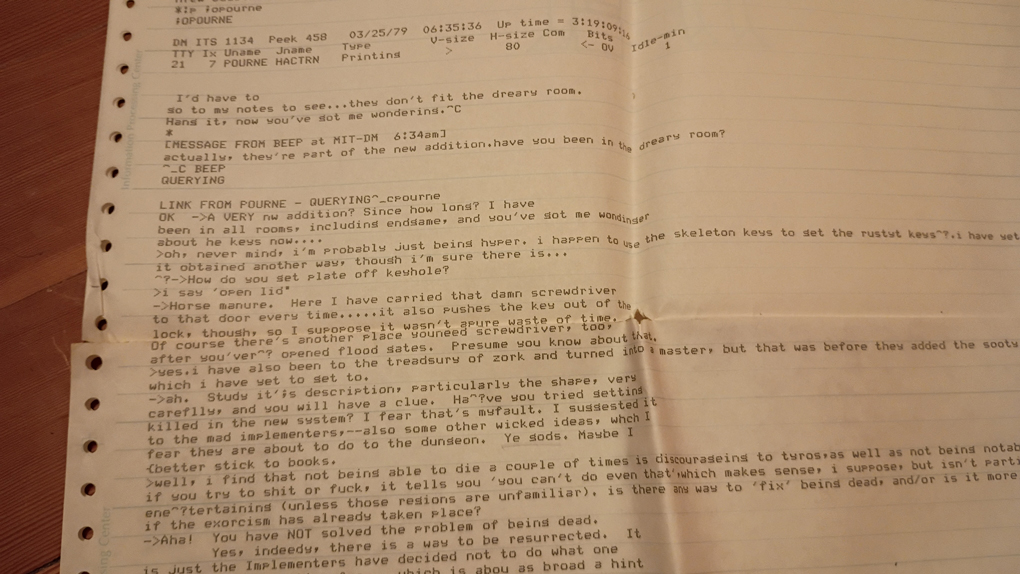
Jerry Pournelle and I chatting about Zork in 1979
[If viewing on your phone, enable Auto-rotate]
AI has been around for 70 years, through three generations. Its current pervasiveness and utility are undeniable. Its limitations and dangers, beyond the effects on jobs, are not nearly as well known. As a software engineer and lifetime programmer, I have some insights to share.
The field of Artificial Intelligence (AI) research was founded at a workshop at Dartmouth College in 1956. MIT’s AI Lab was founded in 1959. AI’s first season ended in the early 1970s as being beyond what computers could do at the time. In the early 1980s, it came back as expert systems, with a lot of programmed decision trees, but maxxed out and faded again by 1990. AI 3.0 took off around 2012 with Deep Learning and artificial general intelligence (AGI). Since 2022 we have large language models, which are very popular and pervasive. They’re so pervasive that they are activated by default, and one has to opt out – if that’s even possible.
While helpful in many circumstances, they can be gamed. As US Senate candidate from Texas, James Talarico, says on his website, “Social media was created to bring us together and keep us informed, but it has evolved into something else. Predatory algorithms elevate the most extreme voices on all sides to provoke our outrage, get more clicks, and make more money. It’s the rage economy. The billionaires who own these platforms are engineering our emotions so they can profit off our pain. We have to do something about it.”
Per electoral-vote.com, I’d like us to “advocate and pass laws assigning legal liability when AI gets something wrong. For example, if a patient is ‘examined’ by an AI doctor at a hospital and the AI doctor makes a mistake and the patient is injured or dies, the law could make it clear that malpractice laws and civil lawsuits most definitely apply to AI doctors, too. In fact, the law could state that any time any AI bot causes injuries to anyone, the organization using the bots has the full legal liability that a human would have under the same circumstances and the organization using the AI can’t pass the blame off to the makers of the AI software. This liability will slow the adoption of AI bots as managers will worry about getting sued if the bots make mistakes.”
Deeper still, AI does analysis, not synthesis. It can connect pre-existing dots. It can interpolate. It can extrapolate. But it can also be gamed. It absolutely cannot anticipate the nonlinearities of life – the effects of running out of air, water, or food; the effects of a system collapsing; the effects of melting an ice sheet, or provoking someone into losing their temper. Most of the time an AI system can handle what a person can handle cognitively. But when it fails, it fails more spectacularly than humans, because humans can bend, can look around the corner, can synthesize new information. AI can only analyze the existing information. Ultimately humans are essential to backstop AI, no matter how sophisticated the code is, because other humans wrote the code, and can’t anticipate everything.