
I Geek Everything, Including
My Family History
It's complicated.
[If viewing on your phone, enable Auto-rotate]
On my “Meet Candidate” page I wrote about my ancestors who came to Oregon, and when. Here I’ll expand on that to detail the unusual diversity of my heritage. I, my parents, and all my grandparents were born in America. So most of the time I’m a fully-assimilated White person who looks a little different but is not clearly identifiable as something else. The next person to guess even half of my non-English ancestry will be the first.
My great-grandparents and their parents is where it gets interesting.
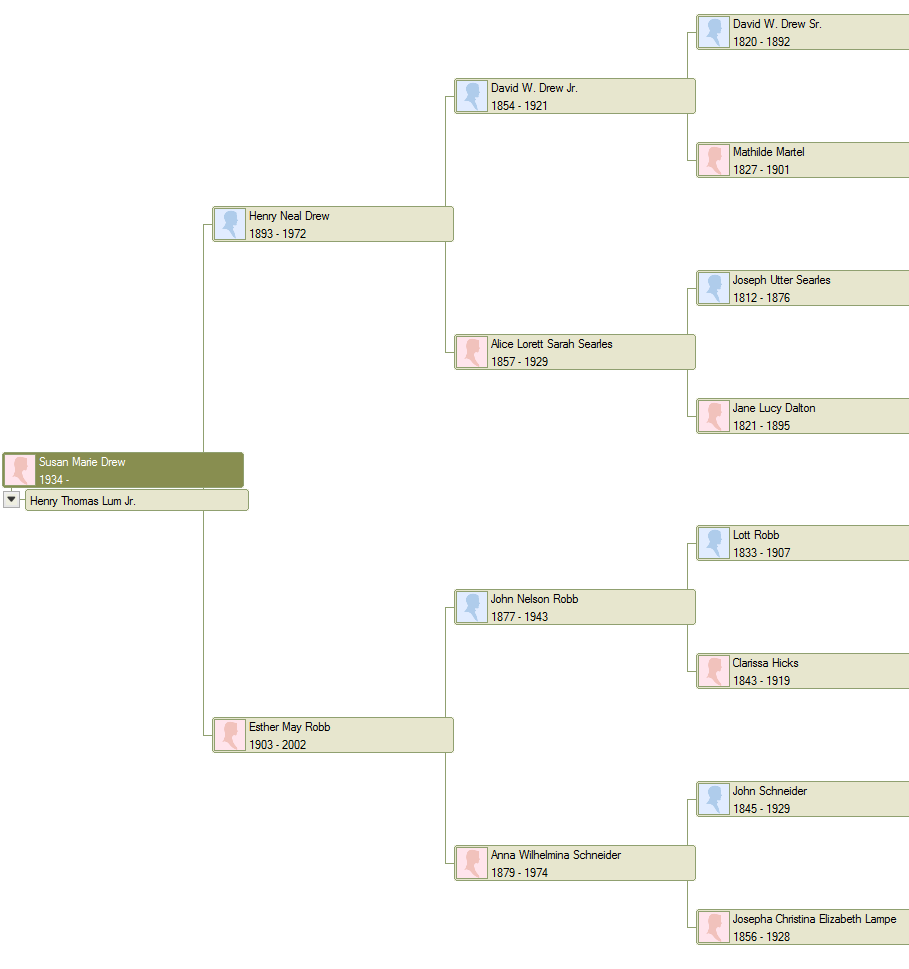
On my mother’s side, her father’s parents David and Lorett came to Oregon from Wisconsin. David’s father was of English heritage and was born at Ft. Snelling, Minnesota, which David’s grandfather helped build. His ancestors were here pre-Revolution. David’s mother was French Canadien, from Yamaska Quebec, whose family moved to Wisconsin in 1840. Her ancestors were in Quebec as far back as 1665 (Honore Martel). Lorett’s heritage was English. One of her ancestors was on the losing (colonial) side at Bunker Hill, and ultimately from him my mother got to be a member of the Daughters of the American Revolution.
Lorett and Esther’s father was Joseph Utter Searle. From Army records, “Age 45, he enlisted at Prairie du Chien on Aug. 9, 1862 in the Union Army. In July 1864 his unit, the 31st Infantry, was transferred to the forces operating under General Sherman and joined that army July 21, 1864, near Marietta, Georgia. It thereafter participated in all the activities of the Atlanta Campaign, being frequently under fire.
“The Thirty-first accompanied the Union forces as a part of the Twentieth Corps from Atlanta to Savannah on the ‘March to the Sea’, November 15 to December 21. It was engaged in the Siege of Savannah, and in the month of January moved out of that city on the Campaign in the Carolinas, in which it participated until its conclusion, when the Confederate forces under Gen. Joseph E. Johnston surrendered to the Union army under Gen. W. T. Sherman. The Regiment was in the front line of battle at Averasborough, NC, March 16, 1865, and very actively engaged at Pentonville, NC, March 19-21, 1865. After the surrender of Johnston April 26, 1865, the Thirty-first marched with the other troops to Washington, DC, where it participated in the Grand Review.”
My mother’s maternal grandparents were John Robb and Anna Schneider. John was English with a wee drop of Scottish, and the Robbs were here pre-Revolution. Anna’s parents were German. Her mother’s parents arrived in America around 1850, and her father arrived around 1870.
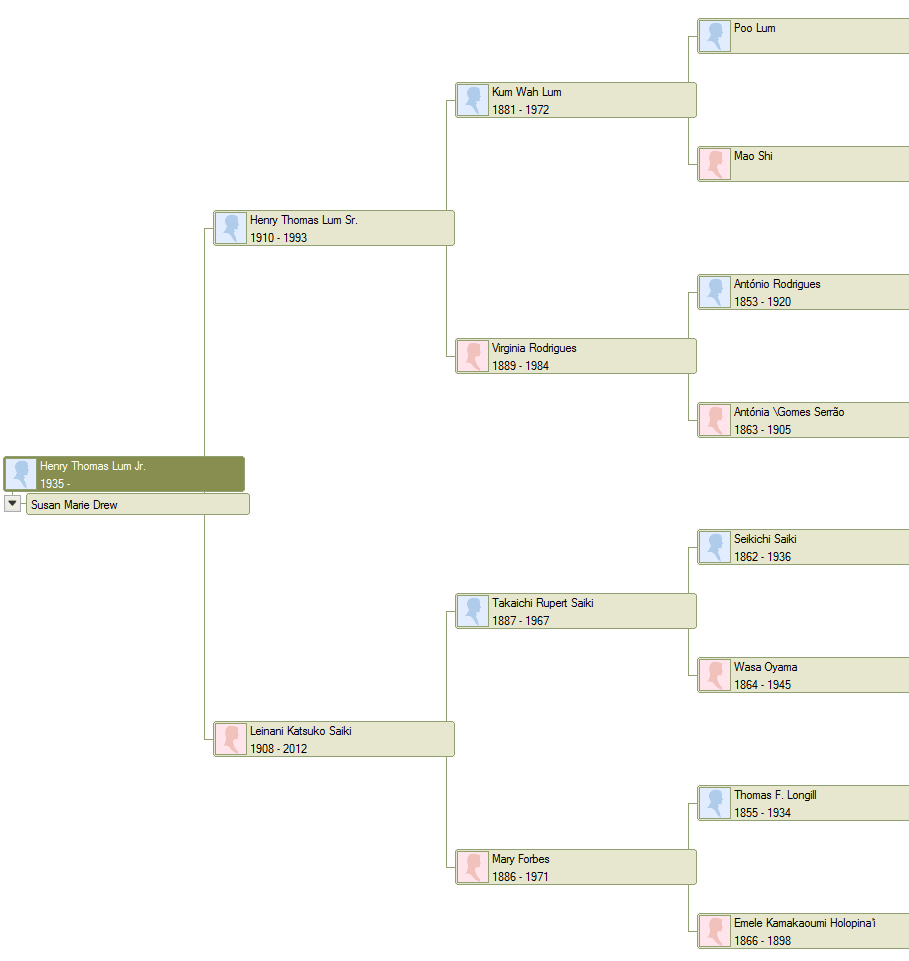
My father’s side is a little more complicated. His father’s parents were Lum Wah and Virginia Rodrigues. Wah arrived in the Republic of Hawai’i from Hong Kong aboard the S.S. Coptic on June 8, 1896 to attend school (USA annexation was in 1898). He ended up working on a sugar plantation, then as a ship’s cook. Virginia was born on Kaua’i. Her parents arrived in Honolulu Saturday, July 7, 1883 from Madeira, Portugal, aboard the S. S. Hankow to work on a sugar plantation
Dad’s maternal grandparents were Takaichi Rupert (T. R.) Saiki and Mary Forbes. T. R. came to Hawai’i on October 28, 1894 aboard the S.S. Nanchang as a seven year old with his parents who left Hiroshima to… work on a sugar plantation. Mary was born in Hawai’i near Hilo. Her father, Thomas Forbes Longill, was born in Nova Scotia of German stock. His family moved to New Bedford, Massachusetts when he was 12. Five years later, he ran away from home by signing onto the whaling barque, S.S. Sea Breeze, on October 2, 1875 in New Bedford. It hunted in the North Pacific. The voyage to get there around South America took four months. After a couple of years, the ship headed back, but he left the ship in Hawai’i to… work on a sugar plantation. He met and married a Native Hawai’ian, Makaoumi who lived on land nearby allocated to her family in the Great Mahele Claim #5157, on January 17, 1848. After they had three children, and while she was pregnant with her fourth, she got leprosy and was exiled to the leper colony on Molokai, where she died 10 years later.
T. R. was arrested in Hilo, Hawai’i on December 7, 1941 and “tried” as an enemy alien on Sand Island in January 1942. I requested and got a FOIA report sent on October 25, 2013. It was Item #146-13-2-21-351 within Box 244 of series title “WWII Alien Enemy Internment Case Files, 1941-51” in Record Group 60. I reviewed the enclosed FBI surveillance and 1942 trial transcripts. It was much like Guantanamo “trials” from the early 2000s. He was an alien because when the USA took over in 1898, White and Native people got American citizenship automatically. OTOH, anti-immigration laws against East Asians were applied retroactively. He was denied citizenship until 1953 (as was Lum Wah). He spent the war in DoJ POW camps in Montana, Louisiana, and New Mexico, and wasn’t released until October 1945.
So for those of you keeping score at home, I’m 1/8 each Chinese, Portuguese, and Japanese; 1/16 Hawai’ian. There is no heritage quota requirement, so even though I am only 1/16 Hawai’ian, I am registered with the State of Hawai’i’s Office of Hawai’ian Affairs as Native. That basically gets me local discounts from restaurants and merchants in Hawai’i that would normally require a State of Hawai’i driver’s license or other proof of local residence.
I’m also 3/16 German, 1/16 French, and 5/16 English. Approximately. One further detail emerged when one of my brothers got a 23 and Me test a few years ago. Our Chinese heritage is a little more nuanced. The main ethnicity in China is Han (90%). But there are others. From the numbers it looks like Wah had one Manchu great-grandparent, two Han Chinese and five Chinese Minority great-grandparents, probably Yue.
I am literally a Chinese man, in that my Y-chromosome is from my various Chinese ancestors. That is also where my meager facial and body hair originated – and probably also the fact that I’ve always looked about 3/4 my age by White standards. My wavy hair (and childhood Catholicism) come from my Portuguese ancestors. But I’m not multicultural or multi-ethnic in any meaningful way. No one ever guesses any of my non-English heritage because it’s so complicated. Every branch of the family’s been here so long (four generations, 130 years minimum) that all that has passed through to me about the cultures of any of my countries of origin is the food, and not much of that. I like poi and li hing mui, though, and I’m good with chopsticks!